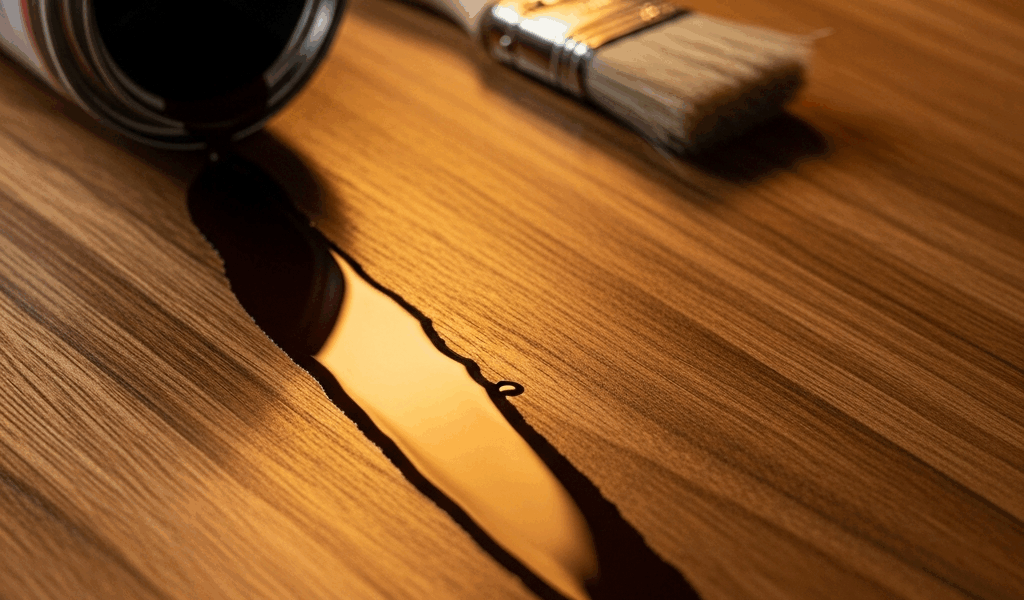
Do not wipe, brush, or scrape a lacquer run while the coating is wet or tacky. Stop spraying, keep the work in the approved ventilated finishing area, remove ignition sources, and let the coating reach the sanding or recoat stage specified by its manufacturer. Most runs can be repaired locally after the film is firm; you usually do not need to strip the entire panel.
Lacquer is not one universal product. Nitrocellulose, acrylic, catalyzed, waterborne, aerosol, and other lacquer systems can have different recoat windows, solvents, protective-equipment requirements, and compatibility limits. Use the exact product label, technical data sheet, and safety data sheet (SDS) as the controlling instructions.
First: stop and make the area safe
- Stop spraying and close the product container as directed.
- Keep flames, pilot lights, sparks, smoking materials, and unsuitable electrical equipment away from flammable vapor.
- Maintain the ventilation required by the coating manufacturer and applicable rules during spraying and while solvent vapor remains.
- Wear the eye, skin, and respiratory protection specified by the SDS. A dust mask does not protect against solvent vapor.
- Do not transfer lacquer thinner into an unapproved pump or drink container. Keep it labeled and stored as the manufacturer and local fire rules require.
- Handle solvent-contaminated wipes and waste according to the SDS and local disposal requirements; do not leave them loose near an ignition source.
OSHA identifies many solvents, lacquers, and coatings used in woodworking as serious fire and explosion hazards, particularly in enclosed or poorly ventilated areas. Its spray-finishing rules require ventilation that controls vapor and residue. A home shop is not exempt from the chemistry simply because the project is small.
Is it a run, sag, or another finish defect?
A run is a narrow downward trail where excess liquid moved under gravity. A sag is a broader curtain or wave of excess coating. Both usually mean the wet film was too heavy for the surface and application conditions.
Do not use this repair for every uneven surface:
- Orange peel is a pebbled texture across a wider area. Use the separate guide to diagnosing and leveling orange peel, while following the instructions for your actual coating.
- Blushing appears cloudy or milky and often involves moisture or solvent conditions.
- Fisheyes are crater-like separations commonly associated with contamination.
- Wrinkling or lifting can indicate incompatible coats, excessive film thickness, or a recoat-window problem. Stop and consult the product manufacturer before adding more material.
Wait for the product-specified repair stage
There is no safe universal instruction such as “wait 24 hours.” Dry time changes with the exact resin and solvent package, film thickness, temperature, humidity, airflow, substrate, and number of coats. A surface that feels dry can still be too soft underneath to level cleanly.
Inspect the Defect Before You Start Leveling
Use clean, raking light from the side so the raised ridge casts a visible shadow. Mark the boundaries on nearby masking tape rather than drawing on the finish. Then inspect the run from several angles. The goal is to identify the material that stands above the surrounding film without confusing reflections, color variation, or a low spot for excess coating.
If the run crosses an edge, molding profile, veneer seam, or sharp corner, the repair becomes less forgiving. Abrasive pressure concentrates on high edges and can expose the substrate before the center of the run is level. Protect adjacent edges where appropriate and use a small, firm backing surface that fits the defect. Do not chase a deep sag into bare wood merely to make the first repair attempt disappear.
Stop periodically, remove sanding residue using the method approved for the coating system, and inspect again under the same light. A uniformly dull surface can hide the remaining ridge, so change the viewing angle rather than automatically removing more finish.
Read the technical data sheet for:
- minimum and maximum recoat time;
- time before sanding or handling;
- approved temperature and humidity range;
- required reducer or thinner, if any;
- compatible abrasives and preparation between coats.
If the sheet does not explain defect repair, contact the coating manufacturer. Do not assume instructions for an aerosol acrylic lacquer apply to a catalyzed cabinet lacquer or a waterborne product.
How to level a cured lacquer run locally
The goal is to remove only the high ridge, then restore an even surface for the next manufacturer-approved coat. Work on an inconspicuous test area first.
- Confirm the film is ready. It should meet the product’s stated sanding or handling interval and should not roll, smear, or clog the approved abrasive immediately.
- Protect adjacent finish. Use a small, firm sanding block appropriate to the surface so pressure stays on the high spot instead of following the run.
- Level gradually. Begin with the abrasive grade permitted by the product instructions. Sand the ridge with short, controlled strokes. Stop frequently, remove dust as directed, and inspect under raking light.
- Feather the boundary. Once the ridge is nearly flush, use the finer preparation specified for recoating. Avoid cutting through at edges, corners, profiles, and stain layers.
- Clean exactly as specified. Some systems call for a compatible solvent wipe; others do not. An unapproved solvent can soften, contaminate, or lift the coating.
- Recoat within the approved system. Apply the next coat at the manufacturer’s recommended wet-film thickness, distance, overlap, pressure, and environmental range.
A sharp scraper or razor can level a hard ridge quickly in experienced hands, but it can also gouge the film or substrate. If the product manufacturer does not recommend that method—or if the surface is curved, veneered, stained, or thinly coated—use controlled abrasive leveling or obtain help from a finisher.
When a local repair is not enough
Stop and reassess rather than repeatedly sanding and recoating when:
- the film stays soft beyond the manufacturer’s stated conditions;
- the run exposes or disturbs stain, toner, veneer, or bare wood;
- large areas have sagged or wrinkled;
- the new coat lifts, crazes, or dissolves the underlying finish;
- the finish may contain lead or another hazardous legacy coating;
- you cannot provide the ventilation, fire controls, or protective equipment required for the repair.
Those conditions may require stripping or professional refinishing, but stripping introduces its own chemical and exposure hazards. Follow the remover’s SDS and local rules, and never mix finishing chemicals unless the manufacturer explicitly authorizes the combination.
Why lacquer runs and sags happen
| Likely cause | What to verify before the next coat |
|---|---|
| Wet coat applied too heavily | Specified film thickness, gun travel speed, fluid delivery, and number of passes |
| Gun or aerosol held too close | Manufacturer’s recommended distance and spray pattern |
| Too much overlap or hesitation | Consistent passes that begin and end beyond the workpiece |
| Incorrect reduction or viscosity | Only the approved reducer, ratio, and viscosity method for that product |
| Surface or coating outside its temperature range | Product, substrate, and room conditions—not air temperature alone |
| Gun setup does not atomize correctly | Air pressure, fluid setting, tip/nozzle, fan pattern, and equipment instructions |
| Contamination or incompatible layer | Cleaning method, substrate compatibility, sealer, and recoat window |
Prevent the next run with a test panel
Before returning to the project, reproduce the same substrate preparation on scrap. Confirm that the coating, reducer, gun or aerosol, temperature, ventilation, and application technique work together. Change one variable at a time.
- Mix or agitate only as the product instructs.
- Set the equipment using its manual and the coating data sheet.
- Spray a light test pass on a vertical panel, where sagging is easiest to detect.
- Check fan shape and atomization before increasing fluid delivery.
- Use consistent distance, speed, and overlap.
- Allow the stated flash time between coats.
- Record the setup that produced an even film.
The site’s lacquer spraying guide covers application setup. For a broad defect map, use the wood-finish troubleshooting guide.
Bottom line
Most isolated lacquer runs do not require stripping the entire panel. Stop spraying, make the area safe, let the exact product reach its approved sanding stage, level only the raised defect, and recoat within the manufacturer’s system. Avoid improvised wet-film wiping, unlabeled thinner containers, universal cure-time claims, and unapproved solvent combinations.


Stay in the loop
Get the latest fine finish wood working updates delivered to your inbox.