How to Finish Pine Furniture Without Blotching
Why Pine Blotches and Why It Is Not Your Fault
If you are trying to figure out how to finish pine furniture and you have ended up with dark, splotchy patches after staining, I want to say something clearly before anything else: you did not make a mistake. I spent years thinking I was doing something wrong every time I stained pine. Too much stain, too little stain, wrong brand, wrong applicator. I tried everything except understanding what pine actually is.
Pine is a softwood with a growth structure that alternates between two very different kinds of wood fiber. Earlywood — the lighter, faster-growing bands — is soft and porous. Latewood — the darker, tighter bands — is dense and hard. When you apply a penetrating stain, those porous earlywood sections drink it in deeply. The dense latewood sections barely absorb it at all. The result is a dramatic contrast that has nothing to do with your application technique and everything to do with the wood’s cellular structure.
That contrast is not a defect. It is literally how the tree grew. Once you understand that, the solution becomes obvious: either control how the stain penetrates, change the type of stain you use, or skip the stain entirely. Those are the three actual paths forward. Everything else is noise.
Solution 1 — Pre-Conditioner (Reduces Blotching, Does Not Eliminate It)
The standard advice you will find on most finishing forums is to use a pre-stain wood conditioner before you stain. That advice is correct. It is also incomplete, and that incompleteness is where most people get into trouble.
Minwax Pre-Stain Wood Conditioner runs about $12 to $15 for a quart at most hardware stores. Varathane makes a similar product. Both work on the same principle: the conditioner partially fills those porous earlywood cells before your stain hits them, so the stain cannot penetrate as deeply into the soft areas. The end result is more even absorption across the surface.
Here is the honest reality — it works, but it reduces blotching by roughly 50 to 70 percent. Not 100 percent. You will still see some variation. If you are expecting mirror-even color, you will be disappointed. If you want to preserve the natural grain character of pine while taking the edge off that harsh blotching contrast, pre-conditioner is a solid choice.
Application matters more than most people realize. Brush it on generously — do not be shy with it. Wipe off the excess with a clean cloth. Then stain within 15 to 30 minutes, while the conditioner is still slightly tacky. Do not let it dry completely. I made this mistake on a pine dresser I was refinishing several years ago — I got distracted, let it dry for two hours, and the conditioner essentially stopped working. The stain blotched almost as badly as if I had skipped the conditioner entirely. Lesson learned the frustrating way.
Pre-conditioner is the right call when you specifically want a stained look that still shows off pine’s natural grain. It is not the right call when you need guaranteed, uniform color on a painted or display piece.
Solution 2 — Gel Stain (Most Control Over Color, No Blotching)
Frustrated by the limitations of liquid penetrating stains, I started using gel stain on pine projects a few years ago and have not looked back for certain applications. Gel stain is a fundamentally different product. It does not penetrate deeply into wood pores. It sits on the surface, staining from the top down rather than soaking in.
General Finishes Gel Stain is what most professional finishers reach for. Available in quarts for around $20 to $25. The color range is excellent — Java, Antique Walnut, and Espresso are particularly popular on pine. Because the gel formula does not penetrate, it does not care about the difference between your earlywood and latewood. It colors both equally. No blotching. Full stop.
The trade-off is real and worth understanding before you commit. Gel stain produces a slightly heavier, more opaque appearance than penetrating stain. You will see color. You will see grain. But you will not get that deep, saturated, grain-enhancement effect that a penetrating stain produces in open-grain hardwoods. On pine specifically, most people cannot tell the difference once a topcoat is applied — but if you are a stickler for grain pop, that is something to consider.
Application technique for gel stain is different from liquid stain. Apply it generously with a foam brush or lint-free cloth. Work it into the surface. Then let it sit for several minutes until it starts to get tacky — not wet, not dry, but tacky. Wipe off the excess in the direction of the grain. For a second coat, let the first cure for at least four hours and repeat. Two coats of General Finishes Gel Stain in Java over pine produces a rich, even, dark finish with zero blotching risk. It is the approach I use now when a client wants stained pine furniture that has to look flawless.
Solution 3 — Skip the Stain and Use a Shellac Seal Coat
Probably should have opened with this section, honestly. For natural pine — meaning you want the warm, honey-colored look of pine without adding stain color — the shellac seal coat technique is what the professionals use, and it is almost completely absent from consumer finishing guides.
Here is the problem it solves. Even when you skip stain and go straight to polyurethane on pine, you can still get uneven sheen and slight color variation as the first coat absorbs differently across the earlywood and latewood. The first coat of oil-based poly soaks into those porous areas and looks dull in spots. You compensate by adding more coats. The finish builds unevenly. It never looks quite right.
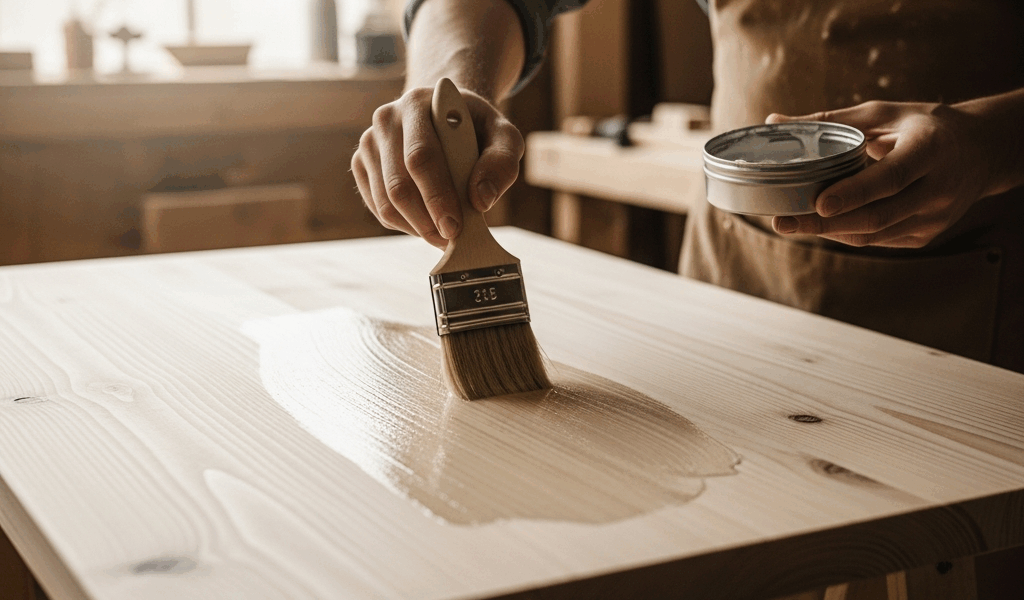
A single seal coat of shellac eliminates this entirely. Shellac is compatible with virtually every topcoat and seals porous wood fibers fast and evenly. The product to use is Zinsser Bulls Eye Shellac — the orange/amber formula for pine, which adds a warm tone that suits the wood beautifully. Cut it to a 1-pound cut by diluting the standard product 50/50 with denatured alcohol in a clean container. Apply one thin coat with a quality natural-bristle brush. Let it dry — shellac dries in about 30 to 45 minutes. Sand lightly with 320-grit. Done.
Humbled by years of fighting pine’s porosity with conditioners and extra coats of finish, I switched to this sequence on a farmhouse table build and the difference was immediate and obvious. Even absorption. Consistent sheen. Beautiful natural pine color.
Clear Finish for Pine — The Complete Sequence
If you want the best possible natural pine finish — durable, even, professional-quality — here is the complete sequence from bare wood to final coat.
- Sand to 220-grit. Go with the grain on the final pass. Remove all dust with a tack cloth or a vacuum and a clean brush. Do not skip to a coarser grit and expect the seal coat to hide it.
- Apply one coat of Zinsser Bulls Eye Shellac at a 1-pound cut (50/50 dilution with denatured alcohol). Brush it on thin and even. Let it dry fully — 45 minutes to one hour at room temperature.
- Sand lightly with 320-grit. You are knocking down any grain raise, not removing the shellac coat. Wipe clean.
- Apply two to three coats of oil-based polyurethane. Minwax Helmsman or General Finishes Arm-R-Seal are both excellent. Arm-R-Seal in satin is my personal preference — it goes on smoothly, levels well, and does not look plastic. Brush on thin coats rather than thick ones.
- Sand lightly with 320-grit between each polyurethane coat after the coat has fully dried — typically 24 hours for oil-based. Final coat gets no sanding.
Three coats of Arm-R-Seal over a shellac seal coat on pine produces a finish that is hard, even, and genuinely beautiful. The shellac-and-poly combination is faster than fighting the blotching problem with conditioners and stain, and the result is more consistent. This is what professional furniture makers use on natural pine. There is no secret formula — just an understanding of why the problem exists and the right sequence to sidestep it entirely.
Whether you go with pre-conditioner for a stained look, gel stain for guaranteed even color, or the shellac-seal-and-poly sequence for natural pine, all three approaches start from the same place: accepting that pine’s porosity is a structural reality, not a problem you can fix by changing how hard you wipe. Work with the wood, not against it, and the finish takes care of itself.



Stay in the loop
Get the latest fine finish wood working updates delivered to your inbox.