The Absence of Reflection
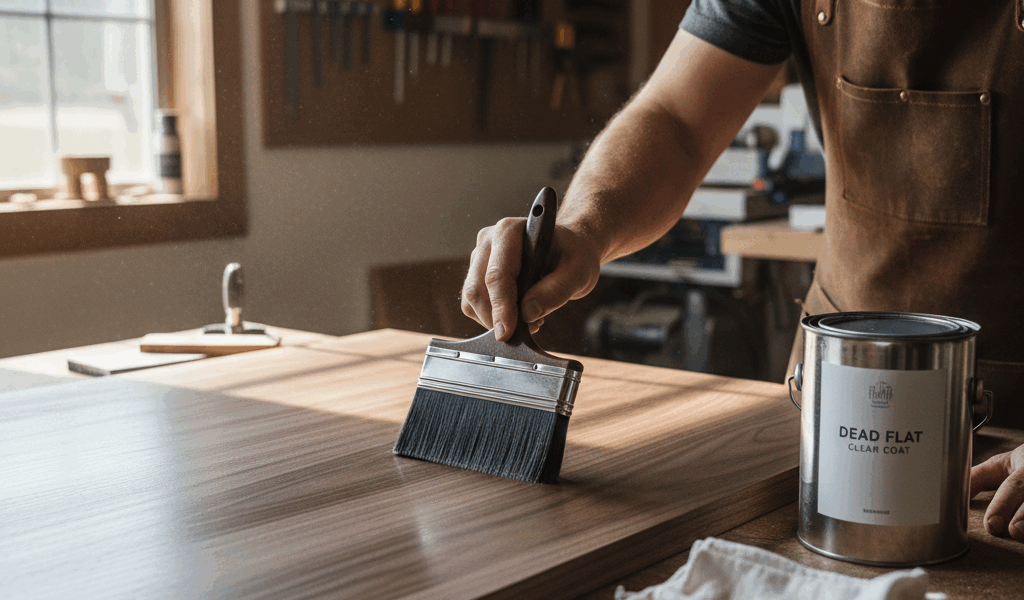
Some pieces demand a finish that refuses to shine. Museum display cases. Contemporary furniture. Scandinavian-inspired designs. Photography studios where reflections ruin shots. These applications require dead-flat matte finish—surfaces that absorb light rather than reflecting it.
True matte finishing is harder than it sounds. Most “matte” products still show some sheen when viewed at the right angle. Achieving absolute absence of reflection requires understanding what creates sheen and systematically eliminating it.
Understanding Flatting Agents
All matte and satin finishes start as gloss formulations with flatting agents added. These microscopic particles (usually silica-based) rise to the surface during drying and create texture that scatters light. More flatting agent means less sheen.
But flatting agents have limits. Add too much and the finish becomes weak, chalky, or won’t cure properly. Manufacturers balance sheen reduction against finish integrity, which is why most “flat” products still show some reflection.
Commercial ultra-flat finishes exist—products designed specifically for dead-flat results. These typically sacrifice some durability for extreme flatness. They work well for low-traffic surfaces but may not withstand heavy use.
The Layering Challenge
Flatting agents don’t distribute evenly. Each coat may settle differently, creating slight sheen variation across the surface. Areas where more material pooled may appear shinier. Overlap zones may show different flatness than primary coverage areas.
This inconsistency is acceptable in satin finishes but becomes visible in ultra-flat work. True matte requires either very consistent application or post-application treatment to even out sheen variation.
Rubbing Out to Dead Flat
The most reliable method for true matte uses the rubbing-out approach. Start with any finish—gloss works fine—and abrade it to the desired sheen. You control the final appearance regardless of what came from the can.
Step 1: Apply your chosen finish (gloss or satin) and allow full cure. Gloss actually works better as a base because it provides a uniform starting point.
Step 2: Wet-sand with 400-grit paper until uniformly matte. The surface should show no glossy spots under raking light. Work systematically to ensure complete coverage.
Step 3: For softer matte texture, follow with 0000 steel wool rubbed with the grain. This creates the ultra-smooth feel expected from quality flat finishes.
Step 4: Clean thoroughly to remove all steel wool particles and sanding residue. Any remaining particles may rust later if the finish is water-based.
Step 5: Apply matte-specific wax if protection is needed. Renaissance Wax or similar museum-grade waxes add protection without adding sheen.
Pumice and Rottenstone
Traditional finishers achieve flat sheen using natural abrasives. Pumice (a volcanic powder) in various grades, followed by rottenstone (a finer natural abrasive), creates beautiful hand-rubbed flat finishes.
Sprinkle pumice on the cured finish, add a few drops of paraffin oil as lubricant, and rub with a felt block. Work until uniform. Follow with rottenstone using the same technique for even finer results. This traditional approach produces exceptionally consistent matte sheen.
Oil Finishes for Natural Matte
If the goal is organic, natural appearance, oil finishes provide inherent matte results. Tung oil, Danish oil, and pure linseed oil all cure to low-sheen finishes. They enhance wood without adding surface shine.
The trade-off is protection level. Oil finishes penetrate rather than building a film, so they don’t resist moisture and abrasion as effectively as lacquer or polyurethane. For appropriate applications—cutting boards, tool handles, decorative pieces—oil’s matte appearance and natural feel are ideal.
Maintaining Flat Finishes
Flat finishes require careful maintenance. Most furniture polishes add sheen—using them defeats the matte effect. Clean only with appropriate products or damp cloths. Never apply silicone-based polishes.
When wear creates glossy patches from friction, the entire surface may need re-rubbing to restore uniform flatness. This is more maintenance-intensive than self-glossy finishes that handle wear better.
Photographing Flat Finishes
One major reason for choosing dead flat is photography. Glossy surfaces create hot spots and reflections that complicate lighting. Flat surfaces photograph predictably. Product photographers, still life artists, and catalog shooters often specify dead-flat finishes for this reason.
If photography is your goal, test your finish under your actual shooting conditions before committing. Some “flat” finishes still show sheen under bright studio lighting. True dead-flat should remain matte from every angle under every light.
The Aesthetic Choice
Dead-flat finishes communicate specific messages. Contemporary. Minimal. Industrial. Serious. The absence of shine reads as intentional restraint—a design choice rather than a default.
This aesthetic suits certain projects perfectly and others not at all. Match the finish’s character to the piece’s intended context. Dead flat on the wrong piece looks unfinished; on the right piece, it looks precisely correct.
Subscribe for Updates
Get the latest articles delivered to your inbox.
We respect your privacy. Unsubscribe anytime.