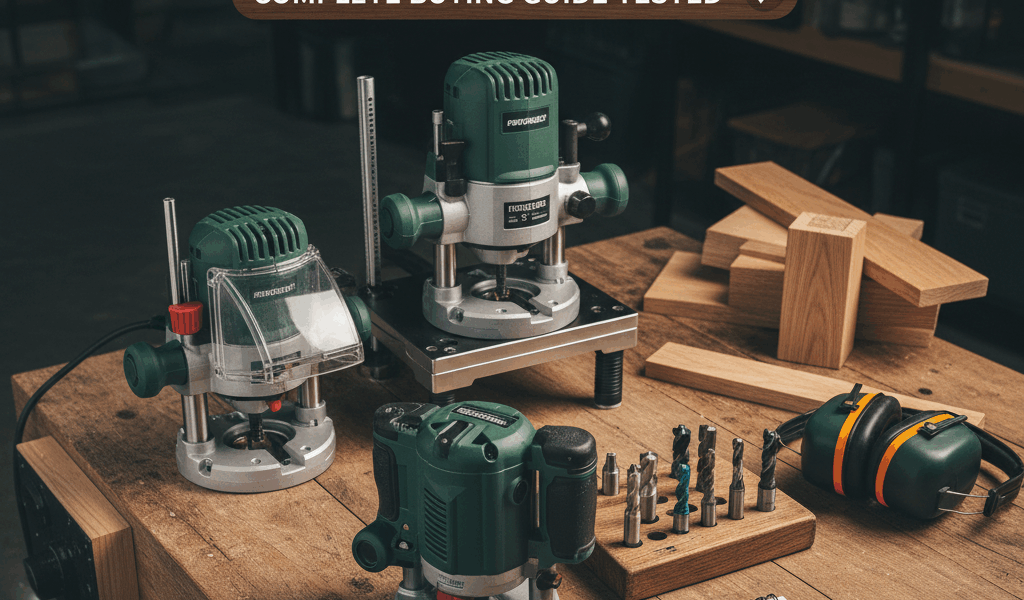
I’ve been routing wood for about fifteen years now, and I still remember staring at the wall of routers at my local Woodcraft, completely lost. The salesman kept throwing around terms like “soft start” and “variable speed” while I nodded along pretending to understand. That router I eventually bought? Terrible choice. Way too heavy, awful dust collection, and the depth adjustment required two hands and a prayer.
So let me save you from making my mistakes.
The Three Types Nobody Explains Well
Walk into any tool store and you’ll see fixed-base routers, plunge routers, and combo kits. Here’s what actually matters:
Fixed-base: The bit stays at whatever depth you set. That’s it. You turn it on, the bit spins at that height until you turn it off. These work great for edge profiles—think roundovers on a tabletop or chamfers on shelf edges. Also the only real option for router table work.
Plunge: Springs let you push the spinning bit down into the wood. Sounds scary (it kind of is at first), but this is how you cut mortises, stopped dadoes, or anything where you can’t enter from an edge. Pull up the handle locks, push down, route your channel, release, and the springs pop the bit back up.
Combo kits: One motor, two bases. More money upfront but cheaper than buying both separately. Most hobbyists eventually want both capabilities anyway.
What I’d Actually Recommend
DEWALT DWP611PK
This is what I tell everyone to buy first. The thing weighs almost nothing—four pounds in the fixed base—which matters way more than people realize. Try holding a heavy router against an edge for ten minutes and your arms will remind you why weight matters.
The LEDs around the base aren’t gimmicky either. My shop has questionable lighting and being able to see my pencil line while routing has saved me from plenty of screwups.
Only real downside: the 1/4″ collet can’t accept larger bits. You’ll eventually want something beefier for raised panels or big roundovers.
Bosch 1617EVSPK
When you’re ready to step up, this is the one. Both 1/4″ and 1/2″ collets included, actual power behind it, and that soft start feature prevents the router from trying to twist out of your hands when you flip the switch. Scared the hell out of me the first time I used a router without it.
The depth adjustment on the fixed base has this satisfying click at every 1/64″ increment. Makes repeatable cuts actually repeatable.
Heavier than the DEWALT though. Noticeably heavier. For handheld work I still grab the smaller one most of the time.
Makita RT0701CX7
Makita’s version of the compact router, and honestly it might have slightly better fit and finish than the DEWALT. The tilt base is unique—lets you cut chamfers at specific angles without building a jig. Whether you’ll actually use that depends on your projects.
The speed dial has good range, from 10,000 up to 30,000 RPM. Most routers don’t go that high on the upper end.
Porter-Cable 690LRVS
Old school. Porter-Cable basically invented the modern router, and this thing reflects decades of refinement. Fixed base only, which I actually see as a feature for beginners—less to think about.
The motor fits Porter-Cable’s plunge base if you decide to expand later. Also works with most router lifts if you build a proper router table down the road.
Build quality feels a step behind the Japanese and German competition these days, but it still works and works well. Plenty of professionals have used these their entire careers.
Ridgid R22002
The value pick. Ridgid’s lifetime service agreement means if something breaks, they fix it. That matters for a tool that spins bits at 20,000 RPM.
Includes edge guides and other accessories that other manufacturers charge extra for. The micro-adjust depth dial works better than it should at this price point.
What Actually Matters When Choosing
Variable speed isn’t optional. Different bit diameters need different speeds—run a 3″ raised panel bit at 25,000 RPM and you’ll burn the wood, break the bit, or worse. Smaller bits need faster speeds for clean cuts.
Dust collection matters more than you’d think. Routers throw chips everywhere. Models with actual dust ports that connect to shop vacs save serious cleanup time and keep the cut line visible.
The depth adjustment mechanism will either make you love or hate your router. Cheap routers have sloppy adjustments that slip during cuts. Good routers lock solid and let you make micro-adjustments without fighting the tool.
Don’t Kill Yourself
Routers deserve respect. The bit spins at ridiculous speeds and will bite hard if given the chance.
Always unplug before changing bits. Always. I don’t care if the switch is off—unplug it.
Feed direction matters: move the router so the bit rotation pulls it into the wood, not away. On outside edges, that means moving left to right. Get it backwards and the router will try to run away from you—this is called climb cutting, and while it has legitimate uses, beginners should avoid it entirely.
Take shallow passes. Trying to hog out too much material in one pass stresses the bit, burns the wood, and makes control harder. Multiple light passes beat one aggressive pass every time.
Hearing protection isn’t optional. Routers are loud, and the high-pitched whine will damage your hearing faster than most shop tools.
Where to Start
Get the DEWALT combo kit. It handles 80% of what most hobbyists need, weighs nothing, and won’t punish you while you’re learning. When you find yourself wanting more power or needing 1/2″ shank bits, the Bosch will be waiting.
Your first project should be something with forgiving edges—maybe a simple box with roundovers, or some picture frames with chamfered edges. Practice on scrap wood first. Seriously. Routers will teach you humility if you skip this step.
The good news: once you get comfortable with a router, it opens up possibilities that would otherwise require expensive specialty tools or years of hand-tool practice. Decorative edges, precise joinery, template work, inlays—all become accessible. Worth the learning curve, I promise.




Stay in the loop
Get the latest wildlife research and conservation news delivered to your inbox.