Best Wood Router for Beginners — What to Buy Without Overspending
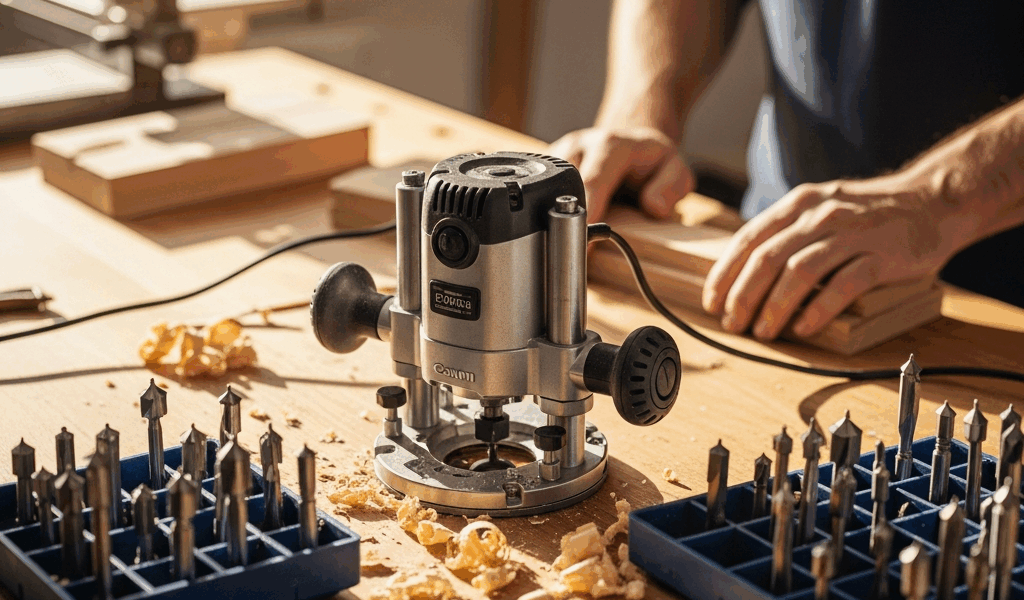
Finding the best beginner wood router has shifted noticeably with all the gear-review noise flying around. Fifteen-model comparisons. Feature breakdowns for tools you won’t touch for two years. Price debates spanning $300 to $2,000. None of that helps you actually buy a router. As someone who has handed a router to roughly two dozen first-timers over the past five years, I got hands-on with which machines work and which ones just frustrate people. Today, I will share it all with you.
This article includes affiliate links. We may earn a commission at no extra cost to you.
The pattern I kept seeing was pretty clear. Beginners who started with fixed-base machines under $150 — almost always — figured things out. The ones who struggled either grabbed used equipment off Craigslist without understanding it, or spent $400 on features they genuinely had no business using yet.
Fixed-Base vs Plunge Router — Start With Fixed
This matters more than brand choice. Seriously.
But what is a fixed-base router? In essence, it’s a motor locked at a single depth you set before switching it on. You lower the bit, lock it, route the wood. The motor stays put. Boring? Sure. Effective? Completely.
A plunge router is the flashier option. It lets you drop a spinning bit directly into a board mid-operation — useful in theory, chaotic in early practice. A beginner managing depth, feed direction, and a spinning bit simultaneously is a recipe for bad cuts. Probably something scarier too.
Save yourself the trouble I had. Convinced I’d outgrown fixed-base work, I bought a Bosch 1619EVS plunge router — paid around $210 for it at a Home Depot in 2018. Two months in, I was still reaching for my old fixed-base for roughly 90% of projects. More stable. Faster setup. The plunge just sat there collecting sawdust until I sold it. That was a $210 lesson.
Your first router should be fixed-base. Straighter edges. More confidence. All ten fingers still attached.
Best Beginner Router Under $150
The Bosch 1617EVS — Industry Standard for a Reason
If I could point every beginner I meet toward exactly one machine, it’s the Bosch 1617EVS. I’ve run the same unit for eight years — still cuts clean, no hesitation. Three woodworkers I personally trained now own them. Two others bought off-brand alternatives and came back puzzled about why their edges looked rough.
The 1617EVS runs a 2.25-horsepower motor in a fixed-base body. Price floats between $99 and $140 depending on sales — I snagged mine during a Memorial Day promotion for $112. There’s also a combo kit bundling the fixed and plunge bases together for around $150 to $170. Skip the plunge base for now. Honestly, just grab the fixed-base version and stop overthinking it.
Why this machine wins:
- The motor runs noticeably quieter than other budget routers. Sounds trivial until you’re in your garage at 7 a.m. and your neighbor’s bedroom window is fifteen feet away.
- Zero wobble. The base is solid, the collet grips bits firmly across all speed settings — no flex, no chatter.
- Parts are everywhere. Replacement collets, dust port adapters, brushes — all of it turns up on Amazon or eBay within minutes. That matters in year three when something finally wears out.
- It grows with you. I’m apparently still a “Bosch loyalist” according to my shop buddy Dave, and this machine handles advanced joinery work without complaint.
- Depth adjustment is intuitive enough that most beginners nail it on their first session. The fence system is equally straightforward.
Cheaper routers exist — DeWalt, Makita, and Milwaukee all sell competent options between $60 and $100. I haven’t put serious hours on all of them. What I do know is this: the Bosch doesn’t fight you. For someone still learning to control a bit spinning at 12,000 RPM, that’s not a small thing.
Features That Matter vs Features That Do Not
The Non-Negotiables
Variable speed control might be the best feature to prioritize, as beginner routing requires working across very different bit sizes and materials. A quarter-inch roundover bit screaming at 24,000 RPM will scorch pine before you’ve finished a single pass. Drop it to 16,000 RPM and you get a clean, crisp edge instead. Many budget routers are locked at fixed speeds near 25,000 RPM — too fast for most of what beginners actually build. The 1617EVS ranges from 8,000 to 24,000 RPM.
Soft-start technology matters too — at least if you’ve ever had a machine jerk sideways when you hit the power switch. Basic routers accelerate instantly. Add a dull bit or heavy wood load, and that torque spike twists the tool in your hands. Soft-start ramps the motor up over about one second. Smoother, safer, cleaner results.
A dust collection port is also non-negotiable. Routing fine hardwood generates dust that coats everything — lungs included. A functional port connected to a shop vac pulls away 60 to 70 percent of debris. Some budget routers ship with ports that look the part but capture almost nothing. The Bosch port actually works. That’s the whole bar and it clears it.
The Distractions
Digital depth readouts? Skip it. Every professional I know uses paper feelers and test cuts on scrap wood. Same results, zero extra cost.
Built-in edge lights? Nice pitch. In practice, most budget-router LEDs are so dim they actually create more shadow than they eliminate. Pass.
Wi-Fi connectivity and app control? Not a joke — some routers now ship with this. Absolutely ignore it. Your router does not need to be on the internet.
Premium carrying cases with molded plastic organizers? You’ll outgrow the included bits in six months. Don’t pay extra for packaging.
First Router Projects to Build Skills
Quick note before the rest of this. Knowing what to build matters as much as which router you buy. Skipping straight to complex projects cost me about four hours of frustration and one genuinely destroyed piece of walnut — $22 of lumber I had to throw in the scrap bin.
Start with roundover edges. Chuck a quarter-inch roundover bit — the Freud roundover bit runs about $14 and is the one I’d grab first — set the 1617EVS to 16,000 RPM, and run it along the edges of a pine 2×4. This teaches feed direction, what smooth actually feels like under your hands, and how bit rotation affects tear-out. Do this ten times before attempting anything more ambitious. Ten times.
Move to rabbets next. A rabbet is a rectangular notch along the edge or end of a board — you’ll cut hundreds of them over the years. A basic rabbet bit and a simple fence introduce depth control and lateral pressure management. Make ten practice cuts on scrap pine. That’s what scrap pine is for.
Dado joints come after that. A dado is a groove cut across a board’s face — wider than a rabbet, running perpendicular to the grain. It teaches consistent depth across longer passes and how to manage lateral drift. This is where your fence technique actually develops.
Dovetails? Save those for month four or five. They’re worth learning. That’s what makes dovetails so endearing to us woodworkers — the payoff is real. But they require muscle memory you’ll only build by moving through the simpler stuff first.
The Bosch 1617EVS, a $14 roundover bit, a basic fence, and four honest hours of practice will make you a more capable woodworker than $600 of gear and no reps ever could.


Stay in the loop
Get the latest fine finish wood working updates delivered to your inbox.